Fundamental Limits and Optimal Methods for Sharp Analytical Causal Bounds in Instrumental Variable Models
TL;DR.
Sharp analytical instrumental-variable bounds cannot stay simple as the outcome alphabet grows. We prove that any sharp bound needs exponentially many linear pieces, and the same exponential barrier appears in the IV inequalities. We also give Python and R procedures that attain this optimal complexity.
Why this matters.
It establishes a genuine complexity barrier for sharp analytical IV bounds: exponential structure is unavoidable. The accompanying algorithms match that lower bound, so the result says both what is impossible and what is optimal.
Abstract
Bounding causal effects analytically, rather than numerically, is appealing for its interpretability and conceptual clarity. Existing sharp methods rely on optimization-based approaches such as the Balke–Pearl framework, whose computational complexity grows rapidly. An alternative line of work derives bounds heuristically using probability laws and generic inequalities, and some recent papers have claimed or conjectured that this approach can yield sharp analytical bounds with substantially lower complexity. In this paper, we show that this perceived advantage is illusory. In particular, in a discrete instrumental variable setting, we show that any sharp analytical bound for the average treatment effect must be expressible as a maximum (minimum) over a collection of linear terms whose cardinality grows exponentially in the number of values taken by the outcome. In parallel, we show that the number of instrumental variable inequalities itself also grows exponentially. Consequently, bounds and inequalities expressed using only polynomially many such terms cannot be sharp. As a constructive complement, the paper is accompanied by codes implemented in python and R to derive sharp analytical bounds and sharp inequalities with optimal computational complexity, matching the lower bounds proven in this paper. These codes are available online.
The paper at a glance
An informal guide to the problem, the idea, and the main results.
1. The problem
Analytical IV bounds are attractive because they are transparent. But classical optimization-based methods become expensive, and it was unclear whether that was only an algorithmic artifact or a fundamental barrier.
2. The key idea
We express the sharp-bound and sharp-testing problems through the geometry of dual polyhedra and cones. For a binary instrument, that geometry can be characterized combinatorially, giving direct generation algorithms instead of generic vertex enumeration.
3. Main result
So even in the binary-instrument case, the sharp formula grows exponentially in the outcome support n.
4. Another result
For general ℓ-valued instruments, we prove corresponding exponential lower bounds, where ℓ is the number of instrument values.
5. How it works
- Write the IV model and the target ATE as linear optimization problems.
- Dualize the problems to expose the relevant vertices and extreme rays.
- Characterize those objects combinatorially when the instrument is binary (ℓ = 2).
- Generate the sharp bound pieces and IV inequalities directly, in time linear in the output size.
What the experiments show
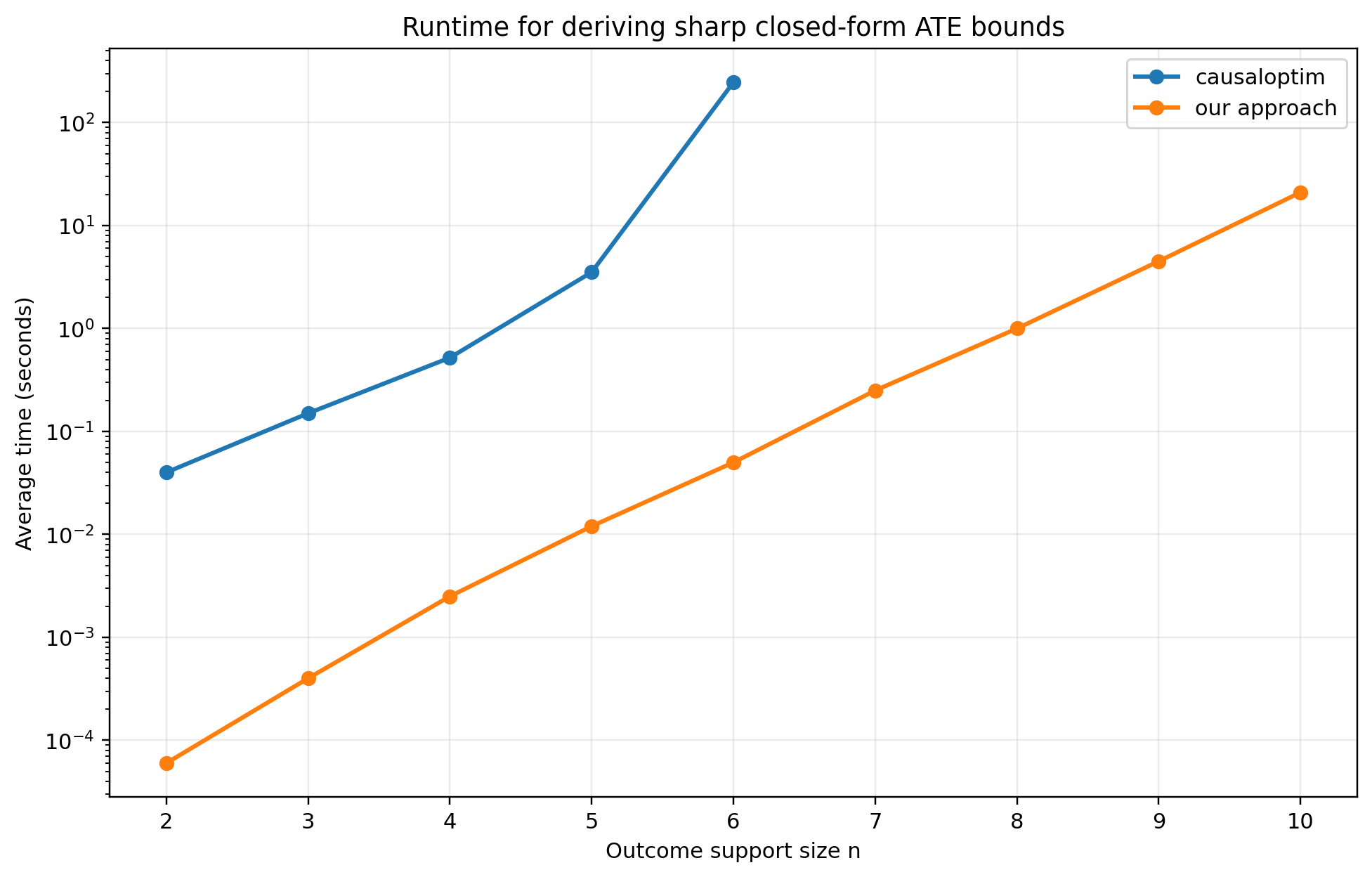
Where this helps
Good fit
- You want exact sharp analytical IV bounds rather than purely numerical bounds for one dataset.
- You need a complete explicit characterization of the IV model's testable implications.
- You want software that automatically derives the full set of sharp bounds and IV inequalities.
- You care about what is fundamentally impossible and what is algorithmically optimal.
Keep in mind
- For binary instruments, we give the complete explicit characterization together with software that generates the sharp ATE bounds and IV inequalities directly.
- For multi-valued instruments, we establish general exponential lower bounds that rule out polynomial-size exact linear characterizations.
Cite this paper
@InProceedings{pmlr-v337-boushehrian26a,
  title     = {Fundamental Limits and Optimal Methods for Sharp Analytical Causal Bounds in Instrumental Variable Models},
  author    = {Boushehrian, Arefe and Badri, Mohammad Reza and Akbari, Sina and Kiyavash, Negar},
  booktitle = {Proceedings of the 42nd Conference on Uncertainty in Artificial Intelligence},
  pages     = {689--744},
  year      = {2026},
  volume    = {337},
  series    = {Proceedings of Machine Learning Research},
  publisher = {PMLR},
  url       = {https://proceedings.mlr.press/v337/boushehrian26a.html}
}