Causal Effect Identification in Heterogeneous Environments from Higher-Order Moments
TL;DR.
Multiple environments can reveal a causal effect even with latent confounding, if the effect stays invariant and the heterogeneity is structured. Higher-order moments identify and estimate the effect when only one part of the data-generating mechanism changes across environments. If both the latent and treatment noise distributions change, identification can fail.
Why this matters.
It turns heterogeneity across environments into identifying information rather than nuisance variation. Under the right invariances, higher-order moments can recover effects that latent confounding would otherwise hide.
Abstract
We investigate the estimation of the causal effect of a treatment variable on an outcome in the presence of a latent confounder. We first show that the causal effect is identifiable under certain conditions when data is available from multiple environments, provided that the target causal effect remains invariant across these environments. Secondly, we propose a moment-based algorithm for estimating the causal effect as long as only a single parameter of the data-generating mechanism varies across environments – whether it be the exogenous noise distribution or the causal relationship between two variables. Conversely, we prove that identifiability is lost if both exogenous noise distributions of both the latent and treatment variables vary across environments. Finally, we propose a procedure to identify which parameter of the data-generating mechanism has varied across the environments and evaluate the performance of our proposed methods through experiments on synthetic data.
The paper at a glance
An informal guide to the problem, the idea, and the main results.
1. The problem
Latent confounding can block identification of a causal effect even when several environments are available. The question is whether cross-environment changes can still be turned into usable identifying information.
2. The key idea
We look beyond means and second moments. Higher-order moments capture asymmetries and other structure that can distinguish candidate causal effects across heterogeneous environments.
3. Identification from one unknown change
With two environments and one unknown change in the data-generating mechanism, we can distinguish whether the change is in a structural coefficient or an exogenous-noise distribution. When the changing component is the latent confounder's effect on treatment or outcome, the treatment effect is uniquely identified; for the noise-shift cases, our procedure narrows it to two candidates.
4. Diagnosing the shift
We give moment-based procedures that identify which component changed across environments and then use the corresponding moment equations to estimate the invariant treatment effect.
5. How it works
- Model how environments differ while allowing latent confounding to remain.
- Express the target causal effect through moment relations across environments.
- Use higher-order moment information to narrow the candidate set of effects.
- Classify the resulting identification regime.
What the experiments show
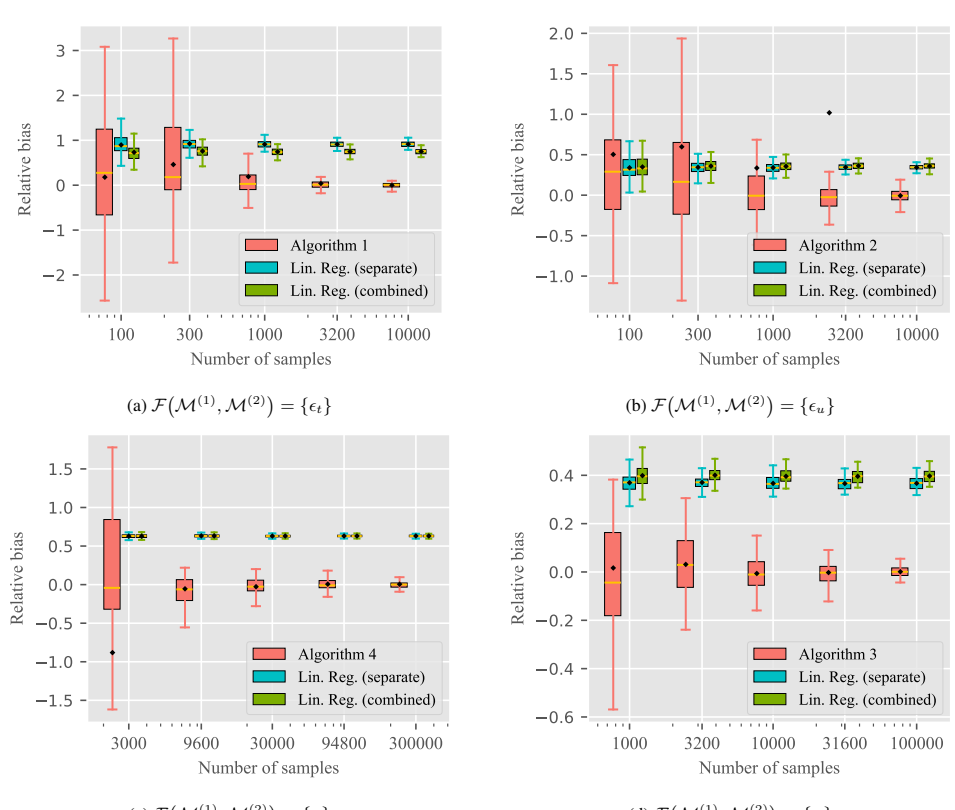
Where this helps
Good fit
- You have data from multiple environments and suspect latent confounding.
- Mean-level variation is not enough, but richer distributional information is available.
- You want to know not only whether identification holds, but also what kind of ambiguity remains when it does not.
Keep in mind
- The core characterization is developed for two environments and extends to larger collections by considering environments in pairs.
- Observed covariates can be incorporated by regressing treatment and outcome on those covariates and applying the method to the residualized variables.
Cite this paper
@InProceedings{pmlr-v286-kivva25a,
  title     = {Causal Effect Identification in Heterogeneous Environments from Higher-Order Moments},
  author    = {Kivva, Yaroslav and Akbari, Sina and Salehkaleybar, Saber and Kiyavash, Negar},
  booktitle = {Proceedings of the Forty-first Conference on Uncertainty in Artificial Intelligence},
  pages     = {2223--2254},
  year      = {2025},
  volume    = {286},
  series    = {Proceedings of Machine Learning Research},
  publisher = {PMLR},
  url       = {https://proceedings.mlr.press/v286/kivva25a.html}
}