CaTs and DAGs: Integrating Directed Acyclic Graphs with Transformers for Causally Constrained Predictions
TL;DR.
Standard neural networks can ignore causal structure that we already know. CaTs and causal fully connected networks bake a user-specified DAG into the architecture, so predictions respect the allowed causal pathways. The aim is better robustness under distribution shift and clearer interpretation without giving up expressive models.
Why this matters.
It lets neural predictors respect causal structure that is known in advance. That can improve robustness to covariate shift while making the allowed information flow much easier to interpret.
Abstract
Artificial Neural Networks (ANNs), including fully-connected networks and transformers, are highly flexible and powerful function approximators, widely applied in fields like computer vision and natural language processing. However, their inability to inherently respect causal structures can limit their robustness, making them vulnerable to covariate shift and difficult to interpret/explain. This poses significant challenges for their reliability in real-world applications. In this paper, we introduce Causal Transformers (CaTs), a general model class designed to operate under predefined causal constraints, as specified by a Directed Acyclic Graph (DAG). CaTs retain the powerful function approximation abilities of traditional neural networks while adhering to the underlying structural constraints, improving robustness, reliability, and interpretability at inference time. This approach opens new avenues for deploying neural networks in more demanding, real-world scenarios where robustness and explainability is critical.
The paper at a glance
An informal guide to the problem, the idea, and the main results.
1. The problem
Standard neural networks optimize predictive fit, but they do not automatically respect known causal structure. That can hurt interpretability and robustness, especially under interventions or distribution shift.
2. The key idea
We use the DAG as an architectural constraint. The network only allows information flow that is compatible with the graph, so prediction is tied directly to the assumed causal structure.
3. Structural guarantee
We prove that the CaT predictive distribution factorizes according to the supplied DAG. The same masked architecture implements the truncated factorization used by the g-formula, so intervention queries identified by the DAG can be computed directly through the network.
4. Robustness guarantee
We prove structural robustness to covariate shift: when the causal mechanisms are shared across domains, shifts in variables that are not ancestors of the target do not change the CaT predictor. The corresponding identified causal queries are transportable in the large-sample limit.
5. How it works
- Start from a known or trusted DAG.
- Translate the graph into architectural constraints on information flow.
- Train the resulting neural predictor with the same data as a standard baseline.
- Evaluate not only predictive performance but also robustness under interventions or covariate shifts.
What the experiments show
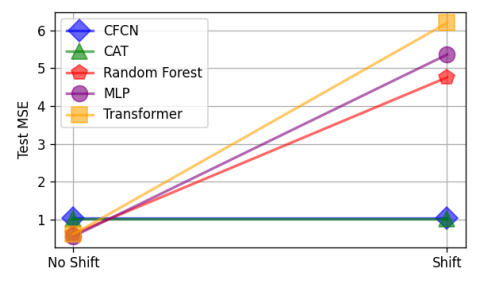
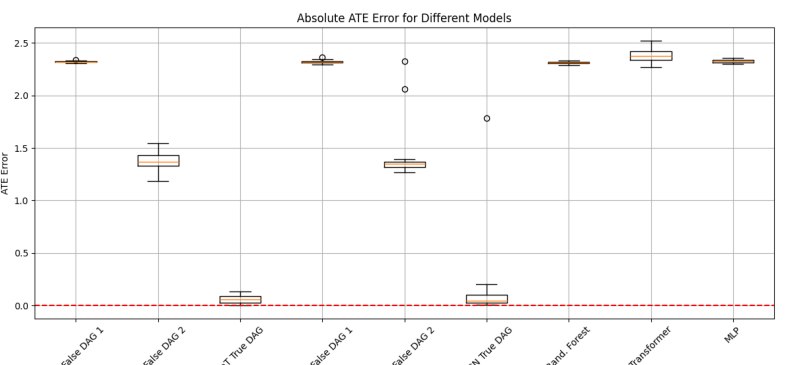
Where this helps
Good fit
- You already know or trust a causal graph and want your predictor to use it.
- You care about robustness to intervention or covariate shift rather than only i.i.d. test accuracy.
- You want a predictive model that is easier to interpret in causal terms.
Keep in mind
- CaT is designed for settings where structural knowledge is available and can be used both for robust prediction and for causal queries identified by the supplied DAG.
- The same masking principle also gives CFCNs, showing that the structural idea is broader than the transformer architecture itself.
Cite this paper
@inproceedings{vowels2026cats,
  title     = {CaTs and DAGs: Integrating Directed Acyclic Graphs with Transformers for Causally Constrained Predictions},
  author    = {Matthew James Vowels and Mathieu Rochat and Sina Akbari},
  booktitle = {The Fourteenth International Conference on Learning Representations},
  year      = {2026},
  url       = {https://openreview.net/forum?id=ZIQactmQxb}
}