Estimating Causal Bounds from Observational Data With Neural Generative Models
TL;DR.
When hidden confounding prevents point identification, we estimate the range of causal effects compatible with the observed data and a given graph. We represent discrete causal mechanisms with neural networks, fit the observational distribution using energy distance, and extrapolate a family of penalised fits to estimate the lower and upper bounds.
Why this matters.
Exact causal-bounding methods can become expensive as models grow, while existing neural approaches can struggle to recover accurate endpoints. Extrapolation uses the behaviour of stable fits to improve bound estimation, with a local theoretical explanation and benchmarks against known sharp bounds.
Abstract
Identifying causal bounds from discrete observational data is a fundamental problem in causal inference. While exact analytical bounds exist for certain graphs, this is not generally the case. In this paper, we introduce a framework for estimating such bounds using neural generative models together with a new extrapolation procedure to estimate these bounds more accurately. Across multiple causal inference settings, it produces bounds that are consistently closer to the true bounds than those obtained with existing general neural approaches. We validate the framework on a range of benchmark problems for which exact bounds are available.
The paper at a glance
An informal guide to the problem, the idea, and the main results.
1. The problem
Different structural causal models can generate the same observational distribution while implying different intervention effects. Finding the smallest and largest compatible effects requires optimising over those models, and neural optimisation becomes unreliable when the observational fit must be extremely precise.
2. The key idea
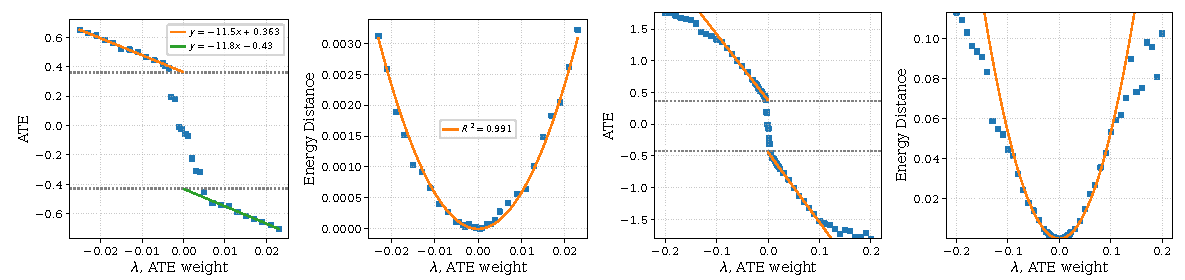
Train neural causal models at several stable, nonzero penalty values, then extrapolate the estimated effects to zero penalty. Positive penalties favour the lower endpoint, while negative penalties favour the upper endpoint. The two regression intercepts estimate the causal bounds.
3. Direct distribution matching
Each node network outputs categorical probabilities. We enumerate the finite observed state space and marginalise latent variables to compute observational and interventional distributions. A differentiable energy-distance loss fits the observed probabilities without adversarial training or sampling categorical outputs.
4. Why extrapolation works
Along a smooth one-sided solution path approaching an exact observational fit, the causal effect changes linearly with the penalty to first order, while energy distance changes quadratically. If the path consists of global minimisers, its zero-penalty intercept recovers the corresponding bound within the neural model family.
5. How it works
- Specify the causal graph and represent each observed variable's mechanism with a neural categorical model.
- Compute the model's observational probabilities and causal estimand by marginalising over latent draws.
- Train models to minimise energy distance plus a signed penalty on the causal estimand.
- Select a stable penalty range using the linear effect trend and the quadratic energy-distance diagnostic.
- Fit separate lines for positive and negative penalties and use their zero-penalty intercepts as the estimated lower and upper bounds.
What the experiments show
Where this helps
Good fit
- You have discrete observational data and a causal graph that allows latent confounding.
- You want lower and upper causal-effect estimates when point identification is unavailable.
- You need a flexible neural approach for settings where exact bounding becomes computationally difficult.
- You want to use optimisation-path diagnostics to improve the accuracy of neural bound estimates.
Keep in mind
- The method enumerates the finite observed state space, so its size remains a computational consideration.
- Extrapolation requires a stable, locally regular penalty range; optimisation can be unreliable very close to zero.
- The bound-recovery result assumes global minimisers and applies within the neural model family. Finite neural fits do not automatically certify population sharpness.
Cite this paper
@misc{zhu2026estimating,
  title         = {Estimating Causal Bounds from Observational Data With Neural Generative Models},
  author        = {Max Zhu and Srivathsan Amruth and Sina Akbari and Qingyuan Zhao},
  year          = {2026},
  eprint        = {2610.25246},
  archivePrefix = {arXiv},
  url           = {https://arxiv.org/abs/2610.25246v1}
}